

For two months this summer, Southern Nevada sellers could point to a number the market had never reached before. In May and June, the median price of a single family home hit $490,000, an all time high. In July, that streak ended. The median slipped to $480,000, a 2% pullback, according to a report from Las Vegas Realtors (LVR). On paper, it read like the start of a cooldown. The rest of the numbers in the same report tell a more complicated story.
LVR’s own data show the total value of single family homes sold through its Multiple Listing Service reached nearly $1.3 billion in July, up 2.1% from a year earlier. Unit sales rose only 1.2% over that same period. Put those two figures next to the falling median, and the picture sharpens: the average sale price actually climbed even as the midpoint fell.
That is not a contradiction. It is what happens when more activity shifts toward higher priced homes while typical, midpoint sales cool. A median tracks the middle of the market. A rising dollar total says the market itself, measured in total transactions, kept expanding.
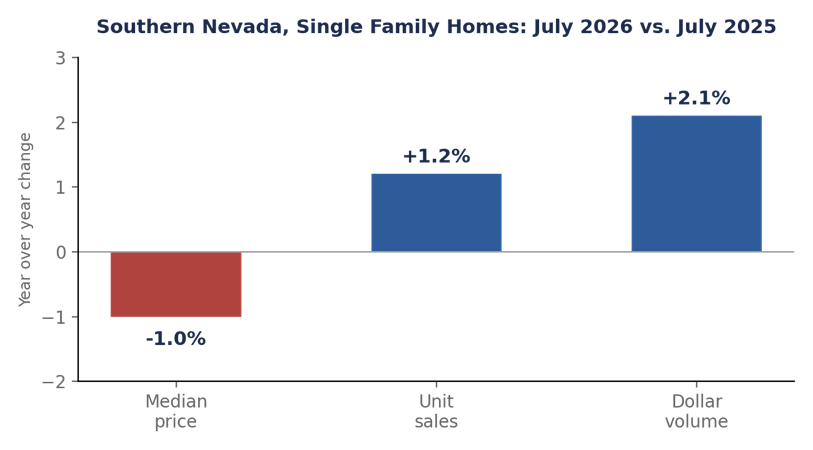
Median price fell while unit sales and total dollar volume both rose. Source: Las Vegas Realtors, July 2026 MLS report.
What the Rest of the Report Shows
Inventory kept climbing regardless of price tier. Single family listings without an accepted offer reached 7,442, up 4.1% from a year ago. Condo and townhome listings without offers hit 2,719, up 3.7%. The condo market itself stayed flat, with a median sale price of $290,000, unchanged from July 2025 and still well below its own record of $315,000 set in October 2024.
Homes are still moving quickly by historical standards. Eighty percent of single family homes sold within 60 days in July, up from 78.8% a year earlier. For condos and townhomes, that figure was 67.6%, down from 73.5%. Sales overall stayed close to last year’s pace, a pace already Southern Nevada’s slowest since 2007. LVR figures show sales have generally trended downward every year since 2021, when a record 50,010 properties changed hands locally.
“Despite the slight decline in prices during July, we’re seeing a steady demand for homes here in Southern Nevada, and that continues to drive home sales and keep prices near record levels,” LVR President George Kypreos said in the report. “That demand has stayed strong even though mortgage rates have remained elevated.”
The Cash Buyer Signal
One number in the report has barely moved at all, and that stability matters. Cash buyers made up 23.9% of July sales, almost identical to 23.8% a year earlier, and far below the 59.5% cash sale peak recorded in February 2013 during the post recession foreclosure wave. Distressed sales, short sales and foreclosures combined, made up just 0.7% of transactions, down from 0.9% a year ago. Whatever is happening to prices this summer, it is not being driven by financial distress in the way the last major downturn was.
Nevada’s Bigger Picture
The July snapshot sits inside a larger state picture. Census Bureau data put Nevada’s median home value at $435,400 for the 2020 through 2024 period, with a typical mortgaged household paying $1,932 a month and median gross rent at $1,597. The Census Bureau also reported 18,540 building permits issued statewide in 2025, evidence that new home construction has continued even as the resale market eases from its highs.
Nevada’s population kept growing through all of it, reaching an estimated 3,282,188 residents as of July 2025, up 5.7% from the Census Bureau’s April 2020 population base. That sustained growth is one of the underlying demand forces keeping prices close to record territory even as the sales pace slows.
What Comes Next
LVR did not offer a forecast. But rising inventory, a sales pace still well below the 2021 record, and a dollar total that kept climbing even as the median fell all point toward a market shifting gradually toward balance, not one in decline.
Southern Nevada’s housing market did not shrink in July. It changed shape, cooling at the middle while still growing at the edges, a distinction the headline price alone does not capture.
Key Data Callouts
| $480,000 Median single family home price in July, down from the $490,000 record set in May and June. | 2.1% Year over year growth in total single family dollar volume, even as the median price fell. | $1,932 Median monthly cost for a mortgaged Nevada homeowner, per Census Bureau data. | 50,010 Record number of Southern Nevada properties sold in 2021, a pace the market has not returned to since. |
| What the Data Says • The median single family price fell 2% from its record, but total dollar volume rose 2.1% year over year. • Unit sales grew just 1.2%, meaning the average sale price rose even as the median fell. • Inventory is up more than 4% year over year for single family homes and 3.7% for condos. • Distressed sales remain near historic lows, at 0.7% of transactions, versus a 2013 cash sale peak of 59.5%. |
| Why It Matters • A falling median does not mean a shrinking market. Buyers and sellers should read both the price and the volume figures. • Sellers face rising competition and should price to current conditions, not last year’s peak. • Population growth of 5.7% since 2020 keeps long term demand pressure in place regardless of monthly price moves. • Elevated mortgage rates, not falling prices, remain the main affordability barrier for typical buyers. |
Sources & Data
• Las Vegas Realtors (LVR), July 2026 Multiple Listing Service report, as reported by FOX5 Las Vegas. https://www.fox5vegas.com/2026/08/06/report-las-vegas-home-prices-pull-back-record-high-july-2026/
• U.S. Census Bureau QuickFacts: Nevada. https://www.census.gov/quickfacts/fact/table/NV/BPS030224
Two Nevadas. Independent local reporting. All figures sourced directly to the issuing agency or organization.