

Nevada’s Governor’s Office of Economic Development approved $17.6 million in tax abatements to nine companies on Aug. 5, including a data center that alone claimed 23.1% of that pool while promising just 10 jobs, a share calculated for this article from GOED’s own press release.
A month later, on Sept. 7, Attorney General Aaron Ford’s office opened a survey asking Nevada ratepayers what they think NV Energy’s data center driven buildout will do to their bills and to the reliability of the grid.
The two actions were not formally connected. GOED’s board, which Gov. Joe Lombardo chairs, approves the abatements. Ford’s Bureau of Consumer Protection, a separate arm of state government, represents ratepayers before the Public Utilities Commission of Nevada.
But the 33 days between them frame a question now central to Nevada’s governor’s race: who should pay for the power that data centers need, and who benefits from the tax breaks that bring them here.
The Fine Print on Nevada’s Newest Data Center Deal
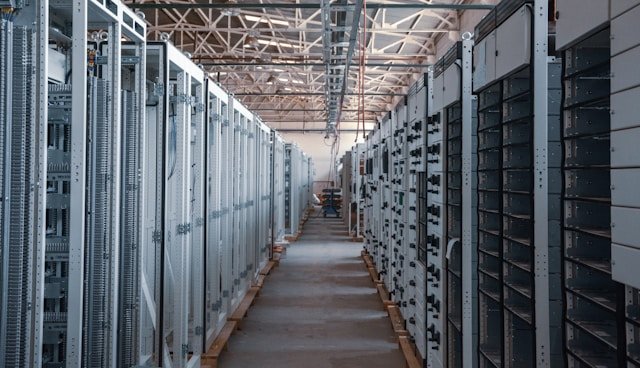
Colovore Reno 1, LLC is building a data center in Storey County. According to GOED’s press release, the company will receive a $4,076,970 tax abatement in exchange for 10 jobs paying an average of $59 an hour and $30 million in capital investment over its first five years.
Divide the abatement by the jobs promised and Colovore’s deal works out to $407,697 per job, a figure calculated for this article and not published by GOED or in any of the trade coverage of the announcement.
The other eight companies approved that day, ranging from a plastics packaging plant to a steel processing center, split the remaining $13,556,408 in abatements across 2,149 promised jobs, or about $6,308 per job, also calculated for this article.
That makes Colovore’s cost per job about 65 times higher than the rest of the batch combined.
| Company | Abatement | Jobs promised | Cost per job |
|---|---|---|---|
| Colovore Reno 1, LLC (data center, Storey County) | $4,076,970 | 10 | $407,697 |
| Other 8 companies combined | $13,556,408 | 2,149 | $6,308 |
| All 9 companies combined | $17,633,378 | 2,159 | $8,168 |
Per-job figures are calculated for this article by dividing each abatement total by the jobs GOED’s press release attributes to that company or grouping.
GOED’s own framing emphasized different numbers. The office’s press release projected the nine companies would generate $174.2 million in new tax revenue against $153 million in capital investment, meaning the batch is projected to return about $1.14 in new tax revenue for every dollar invested, a ratio calculated for this article.
Colovore alone was credited with $16.8 million of that projected revenue on $30 million invested, a return of about 56 cents per dollar invested, roughly half the batch’s overall rate and also calculated for this article since GOED did not break out the ratio by company.
What NV Energy’s Own Filing Says Is Coming
The Colovore abatement is a small piece of a much larger shift already showing up in NV Energy’s regulatory filings. Data centers accounted for about 5% of NV Energy’s total electricity sales in 2026, according to the utility’s 2026 Integrated Resource Plan as summarized by Western Resource Advocates, a clean energy nonprofit that reviewed the filing.
NV Energy itself projects that share will reach 64% of total sales by 2046, and as high as 82% of sales for Sierra Pacific Power Company, the utility’s northern Nevada subsidiary that serves the Reno area. That is nearly a 13 fold increase in data centers’ share of the utility’s total sales over 20 years, a ratio calculated for this article from NV Energy’s own projections.
To meet that demand, NV Energy has told regulators it needs roughly 4,370 megawatts of new solar capacity, 5,405 megawatts of battery storage, 180 megawatts of geothermal generation and 1,223 megawatts of new gas fired turbines over the next six years, according to Nevada Current’s review of the filing.
The utility has told regulators it has received inquiries for 22 gigawatts of potential data center load and has already signed executed infrastructure agreements covering 6 gigawatts, and it expects to miss its 2027 renewable energy targets in part because of data center demand.
NV Energy has also told investors it plans more than $3 billion in Northern Nevada infrastructure spending over the next three years, on top of a $4.2 billion transmission project called Greenlink and $388 million in additional Southern Nevada spending through 2029, per Nevada Current’s reporting on the utility’s regulatory filings. NV Energy serves about 2.4 million electric customers statewide, according to the utility’s own published company facts.
A Formal Survey Opens, Weeks After the Abatement
Ford’s office says its new survey replaces an in-person consumer session that the Public Utilities Commission of Nevada determined was not in the public interest.
The survey is tied to PUCN Docket No. 26-05007, NV Energy’s pending Integrated Resource Plan case, which the commission must decide by Dec. 31, 2026. “By taking this survey, Nevadans can help my office understand the concerns and worries they face in our state,” Ford said in the announcement.
The survey itself asks about three things: how data center growth could affect monthly electricity costs, whether ratepayers are concerned about grid reliability as demand rises, and general feedback on NV Energy’s long-term resource plan. It remains open through the PUCN’s Dec. 31, 2026 decision deadline on the case.
The Fight Over Who Decides
The timing lands in the middle of a contested race for governor. Ford, the Democratic nominee and current attorney general, has pledged to pause new data center tax abatements if he defeats Lombardo in November. “Data centers are swarming into Nevada communities, draining our water, and jacking up our energy bills,” Ford’s campaign said in a position paper reported by Nevada Current.
Ford’s campaign has separately said it would require data centers to supply their own water or coolant, ban water intensive evaporative cooling, and require companies to cover the full cost of the electricity infrastructure they need rather than passing it to other ratepayers.
Ford’s campaign has cited its own historical abatement totals to make its case: about $97 million in data center tax breaks approved in the 2021-22 state budget cycle and nearly $240 million in the 2023-24 cycle, a combined $337 million over two cycles, according to figures the campaign provided to Nevada Current.
Those are the campaign’s own figures rather than numbers independently published by GOED in the same format, so they are presented here as Ford’s claim rather than a verified state total.
Lombardo, the Republican incumbent, supports continued data center development with conditions. He has said projects need “responsible plans in place for water usage, energy generation and infrastructure demands,” and has warned against letting “misinformation” about the industry spread, according to a Washington Examiner report on the race. His administration’s GOED board approved the Colovore abatement, along with the eight others, on Aug. 5.