

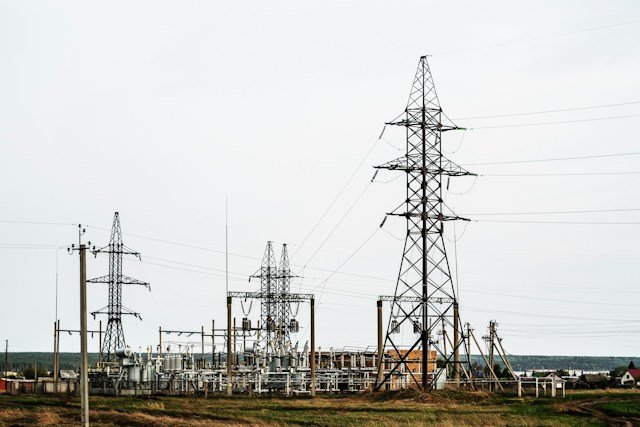
CARSON CITY, Nev. Nevada utility regulators on Thursday approved construction of two private methane gas power plants that will generate a combined 362 megawatts to run a data center campus east of Reno, after nearly three hours of public testimony against the project.
The next day, Gov. Joe Lombardo signed an executive order billed as forcing data center developers to “play by our rules” on taxes, water and grid costs. Neither the renewable energy law the state already has, nor the new rules the governor just signed, reaches the project approved a day earlier.
The two are separate actions by separate parts of Nevada government, and nothing requires them to line up. But together they show the gap between how Nevada regulates the power plants a data center builds for itself and how it regulates the tax breaks that same data center might later ask for.
Two Gas Plants, Approved Over Nearly Three Hours of Objection
The Public Utilities Commission of Nevada voted Thursday to let Tract Capital Management, through its subsidiary Fleet Data Centers, build the South Valley and Peru Ridge power plants at the Tahoe Reno Industrial Center in Storey County, less than 30 miles from Reno.
The two plants, filed with the commission as dockets 26-04026 and 26-04027, will generate 144 and 218 megawatts respectively, enough combined capacity to power roughly 396,000 homes. They are meant to bridge the two to three years the company says it will take NV Energy to deliver permanent utility service to the site.
A Tract Capital Management spokesperson told regulators the plants would come at “zero cost to Nevada residents,” since the company, not ratepayers, is paying for them. That framing did not satisfy the commission’s critics.
PUCN General Counsel Garrett Weir told the crowd it was “tragic that folks show up with expectations that aren’t realistic about what the public comment can actually achieve,” a comment the Nevada Attorney General’s office publicly disputed.
“The PUCN failed to account for evidence that was placed directly before them,” said John Sadler, communications director for the Attorney General’s office, after commission staff argued the public testimony wasn’t part of the evidentiary record.
Commissioners defended the vote as bound by process. PUCN Chair Hayley Williamson said commissioners have “statutory constraints on what evidence they can consider,” and Commissioner Tammy Cordova said she would be “failing in my responsibility” if she held this applicant “to a different standard or a different set of laws” than any other.
Commissioner Randy Brown added that “no permit will be issued without proper state agency oversight.”
Nevada’s Renewable Law Says 34%. This Project’s Requirement Is Zero.
Nevada’s Renewable Portfolio Standard requires 34% of electricity from renewable sources for 2024 through 2026, rising to 42% for 2027 through 2029 and 50% starting in 2030, with no energy efficiency credit allowed toward that total starting this year.
NV Energy, the state’s dominant utility, is already well ahead of the requirement: the company reported 47.5% renewable compliance for 2025, more than 13 percentage points above what the law demanded.
The South Valley and Peru Ridge plants answer to none of that, because the standard applies only to “providers of electric service” that sell power to Nevada customers, not to a company generating power solely for its own use.
Fleet Data Centers has told regulators it is exempt on exactly that basis, arguing it is “not subject to Nevada’s renewable portfolio standard, because they are not energy providers like NV Energy.”
George Cavros, an attorney speaking on behalf of Nevadans for Clean Affordable Reliable Energy, disputes that reading: “there is no self-generation exemption to those statutes,” he told regulators, warning the approval “will inevitably lead to thousands upon thousands of megawatts of dirty data center development in Nevada.” The dispute was not resolved before Thursday’s vote, and the plants were approved regardless.
| Requirement | Renewable share |
|---|---|
| Nevada’s Renewable Portfolio Standard, 2024 to 2026 | 34% |
| NV Energy’s actual 2025 compliance | 47.5% |
| South Valley and Peru Ridge plants’ renewable requirement | 0%, by the company’s own claimed exemption |
What 362 Megawatts of Gas Adds to Nevada’s Emissions
Nevadans for Clean Affordable Reliable Energy’s own analysis, reported by This Is Reno, found the two plants would emit nearly 980 pounds of carbon dioxide per megawatt hour and would have added “approximately 12%” to Nevada’s emissions had they been running in 2025. That figure is worth checking against the state’s own accounting rather than repeating as given.
Running both plants at full capacity for a full year, a calculation performed for this article, works out to roughly 1.41 million metric tons of carbon dioxide annually.
Measured against the 12.218 million metric tons Nevada’s entire electric power sector emitted in 2023, the most recent year in the state’s own greenhouse gas inventory, that comes to about 11.5%, closely matching the advocacy group’s “approximately 12%” figure.
But measured against Nevada’s total statewide emissions of 39.61 million metric tons that same year, across every sector of the economy, it comes to only about 3.6%. The widely cited 12% figure describes the power sector alone, not Nevada’s carbon footprint as a whole, a distinction that has not been spelled out in the coverage of this project so far.
A Day Later, New Rules That Don’t Reach This Project
Gov. Lombardo’s Friday order, Executive Order 2026-005, requires data center developers seeking tax abatements through the Governor’s Office of Economic Development to pay the Local School Support Tax in full and to sign a “community support commitment” ensuring they, not other electric customers, cover the cost of their own water and power.
Currently, data centers can get most of their sales tax abated and pay a reduced 2% rate; the order raises that effective floor to 4.6% by exempting the schools tax from abatement, still well under the 8.375% combined rate Clark County residents pay on ordinary purchases. The 75% abatement on data centers’ personal property tax is untouched.
The order applies only to future projects seeking new GOED abatements, not to the tax breaks already on the books. Existing data center facilities have cost Nevada nearly $340 million in lost tax revenue over fiscal years 2021 through 2024, and Lombardo’s administration has handed out $240 million in data center tax breaks so far.
Neither figure is affected by Friday’s order. GOED’s executive director must publish the standard commitment terms companies will have to sign by Nov. 6, 2026.
None of it touches South Valley or Peru Ridge. Those plants were approved by the PUCN under its authority over electric generation, not by GOED under its abatement program, and Fleet Data Centers has not been reported seeking a GOED tax abatement for the power plants themselves.
A project can clear the state’s newest, most publicized data center guardrails simply by not asking for the kind of tax break those guardrails were built to condition.
What the Executive Order Actually Covers
- Applies only to data center developers who apply for new tax abatements through GOED going forward, not to existing abatements or to projects that never seek one.
- Raises the effective sales and use tax floor on abated data centers from 2% to 4.6% by exempting the Local School Support Tax from abatement.
- Leaves the 75% personal property tax abatement unchanged.
- Requires a signed “community support commitment” covering water, power costs and grid reliability, with standard terms due from GOED by Nov. 6, 2026.
- Does not address, and by its own terms does not reach, self-generating power projects like the South Valley and Peru Ridge gas plants, which were approved through a different agency under a different statute.
Nevada’s attorney general, Aaron Ford, is also the Democratic nominee running against Lombardo this fall, and his office and his campaign responded to the two actions separately. Sadler’s statement Thursday, issued by the Attorney General’s office in its regulatory capacity, challenged how the PUCN handled public evidence in the gas plant docket.
Ford’s campaign, in a separate response to Friday’s executive order, has previously pledged to pause data center tax abatements if elected and has pointed to the $240 million issued under Lombardo to argue the order does not go far enough.
The two responses came from the same office and campaign, a day apart, aimed at two different actions that, on the numbers, do not overlap at all.
Sourcing: The Thursday PUCN vote, plant capacities, docket numbers, home-equivalent figures, public comment length, and all commissioner, general counsel, Attorney General’s office and company quotes are drawn directly from Nevada Current’s Sept. 18, 2026 report. Docket numbers and the two to three year bridge timeline are cross-checked against the Nevada Independent’s April 29, 2026 report on the same dockets. The 980 lbs CO2/MWh and “approximately 12%” emissions figures, and the Cavros and company exemption quotes, are drawn directly from This Is Reno’s Sept. 1, 2026 report. Nevada’s RPS percentages and the “providers of electric service” statutory scope are drawn directly from the Public Utilities Commission of Nevada’s own published RPS summary. NV Energy’s 47.5% 2025 renewable compliance figure is drawn directly from Fox5 Vegas’s April 20, 2026 report. Nevada’s 2023 electric-sector and total statewide greenhouse gas emissions figures (12.218 and 39.61 million metric tons respectively) are drawn directly from the Nevada Division of Environmental Protection’s own 2025 statewide greenhouse gas inventory report. The 1.41 million ton emissions estimate, and its comparison to both the electric-sector and total statewide 2023 figures, are original calculations performed for this article and do not appear in any single underlying source. The executive order’s tax provisions, scope, $340 million and $240 million figures, and Nov. 6, 2026 deadline are drawn directly from Nevada Current’s separate Sept. 18, 2026 report on the order, cross-checked against Fox5 Vegas and This Is Reno’s own Sept. 18, 2026 coverage of the same order. Clark County’s 8.375% combined sales tax rate is drawn directly from Avalara’s published 2026 rate table.