

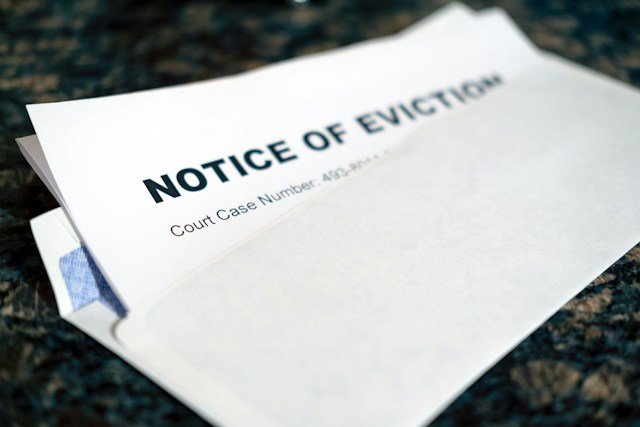
LAS VEGAS, Nev. A mother of three children, ages 9, 13 and 14, stood before a hearing master at the Las Vegas Justice Court this month, behind on rent since August. Her landlord’s representative appeared by video. The hearing lasted about two minutes. Hearing master Daniel Westmeyer granted the eviction but stayed it for 10 days.
That case was one of roughly 78,000 eviction filings logged in Nevada courts in the 2025 fiscal year, according to a Nevada Supreme Court report cited by Nevada Current. Housing advocates gathered this month to call eviction court the “culminating venue” of the state’s affordability crisis.
What they did not say, because the state’s own numbers do not put the two side by side, is how much of Las Vegas Justice Court’s entire civil workload those filings actually represent.
The Math Nevada’s Courts Don’t Publish
Two separate counts, read together, answer that question. The Nevada Independent reported in September that more than 53,600 of the state’s roughly 78,000 eviction filings, about 68%, were filed in the Las Vegas Justice Court alone in 2025.
Separately, the Nevada Judiciary’s own fiscal year 2025 annual report shows Las Vegas Justice Court took in 98,639 civil case filings of every kind that same year, down slightly from 99,259 the year before.
Nevada law treats summary evictions as civil filings in justice court, so the two figures describe the same docket. Divide one by the other and evictions account for roughly 54% of every civil case filed in Las Vegas Justice Court in fiscal 2025, a calculation neither the court’s annual report nor the Nevada Supreme Court’s filing count makes on its own.
That means the single largest category of civil business at Nevada’s busiest lower court was not a contract dispute, a small claim or a personal injury suit. It was someone losing their home.
The two sources are not far apart on the raw eviction count either. Nevada Current put the Las Vegas Justice Court figure at about 54,000, which lines up with the Nevada Independent’s more precise 53,600, both pointing back to the same underlying Nevada Supreme Court data.
The statewide total was also down from nearly 85,000 filings in fiscal 2024, a roughly 8% decline that Nevada Current ties to the earlier expiration of pandemic-era eviction protections and rental assistance funding rather than any new policy change.
Decided in Minutes, by Someone No One Elected
Those cases are not necessarily heard by one of the court’s elected justices of the peace. Since a 2016 administrative order, Las Vegas Justice Court has routed summary evictions through a dedicated department staffed by hearing masters, appointed officials rather than elected judges. The Legal Aid Center of Southern Nevada is now asking the Nevada Supreme Court to cancel that order entirely.
The lawsuit, filed Sept. 4 on behalf of tenant Darchelle Garnett, argues the 2016 order created a new judicial department without legislative authorization and gave hearing masters final decision-making power the Nevada Constitution reserves for elected judges.
In Garnett’s own case, the same hearing master who handled this month’s two-minute hearing, Daniel Westmeyer, heard her eviction on Aug. 20 in under five minutes and granted a delayed summary eviction over late fees her attorneys say exceeded what state law allows. The ACLU of Nevada has said it plans to file a brief backing the petition.
Jonathan Norman of the Nevada Coalition of Legal Service Providers says the stakes extend well past any single hearing. An eviction record can follow a tenant for up to seven years, he said, long enough to affect a renter’s ability to find new housing well after a case is resolved.
As of this month, the Nevada Supreme Court had not ruled on the petition, and the Las Vegas Justice Court did not respond to the Nevada Independent’s questions about how many hearing masters handle these cases or how they are assigned.
What the Lawsuit Argues
- No legislative authorization. The 2016 administrative order creating a summary eviction department run by hearing masters was never approved by the Legislature, the petition says.
- Final say without review. Hearing masters may assist elected judges under state court rules, the petition argues, but their rulings are supposed to stay subject to review by an elected judge, not stand as the final word.
- A due process problem. Attorneys for Garnett say the court’s own posted rule changes conflict with Nevada Supreme Court requirements, and that the Supreme Court alone has authority to set rules governing court proceedings.
- No response to a faster fix. A July 20 request asking the chief judge to have elected judges hear these cases within 30 days drew no action, according to the petition.
How Nevada Lawmakers Have Tried, and Failed, to Change This
- 2021: A bill to reform the summary eviction process was converted into a study bill instead. A separate 2021 law pausing eviction proceedings while rental assistance applications were pending expired in 2023.
- 2023: The Legislature passed a summary eviction reform bill. Gov. Joe Lombardo vetoed it.
- 2025: Lawmakers passed another eviction reform bill, plus a 10% rent cap for seniors and, after it was scaled back, a 5% version. Lombardo vetoed the eviction bill and both rent cap versions. His office points instead to a $21 million eviction diversion and rental assistance allocation approved that year and a separate rental fee transparency law he signed.
- 2027 (planned): Presumed incoming Assembly Speaker Elaine Marzola is expected to carry a new summary eviction reform bill, alongside a renewed 10% senior rent cap, habitability law changes and automatic sealing of eviction records.
A Campaign Issue, Too
The timing puts the fight squarely inside Nevada’s governor’s race. Attorney General Aaron Ford, challenging Lombardo this November, has said he would support shifting more of the legal burden in eviction cases onto landlords and backs limits on rent price-fixing, the same policy area behind a 2025 bill Lombardo vetoed. Ben Iness of the Nevada Housing Justice Alliance, who organized this month’s press conference, said Nevada “lacks protections against rent hikes and rent gouging” and called eviction court the place where that gap becomes unavoidable for tenants.
Lombardo’s office has defended its record on process rather than on the vetoes themselves, pointing to the diversion funding and fee transparency law as evidence the administration is addressing affordability without the policies it rejected.
Neither side disputes the underlying count: tens of thousands of eviction cases are still moving through a Las Vegas courtroom process built around hearing masters, not elected judges, while the court that oversees them has not said how many hearing masters it employs or how their caseloads are assigned.
The Nevada Supreme Court petition remains pending, with no ruling issued as of this month. Until it is decided, every one of those cases, the majority of the busiest civil docket in the state, will keep moving through the same hearing masters whose authority is now the question in front of the state’s highest court.