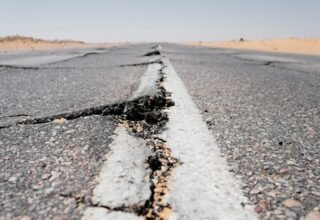

The National Weather Service has an Excessive Heat Warning in place for Southern Nevada that started at 10 a.m. Tuesday and runs through 8 p.m. Friday, with highs of 107 to 110 degrees across the Mojave Desert region. Harry Reid International Airport hit 108 degrees on Monday, well above the normal mid-August high of 103.
Underneath that heat sits a quieter number with its own countdown. The federal government’s most recent monthly outlook for the Colorado River system, published July 15 by the Bureau of Reclamation, projects Lake Mead falling to an elevation of 1,035.86 feet by the end of November.
That is less than a foot above the exact elevation the bureau’s own planning documents identify as the point where Hoover Dam’s hydropower becomes too costly to be worth producing.
A Record Already Broken Underneath the Heat
Lake Mead touched a new low of 1,040.5 feet on August 7, edging past the previous record of 1,040.58 feet set in July 2022 and marking the lowest reading since the reservoir first filled behind Hoover Dam in the 1930s.
The Bureau of Reclamation’s July 24-Month Study, the government’s standard monthly planning document for the Colorado River, projects the reservoir will keep dropping through the fall: an average elevation of 1,038.94 feet for August, 1,037.17 feet for September, 1,037.26 feet for October and 1,035.86 feet for November, before edging back up slightly to 1,037.31 feet in December.
Why 1,035 Feet Is the Number That Matters
That November projection lands just 0.86 feet above a threshold spelled out in the bureau’s own technical planning for post-2026 Colorado River operations.
The agency’s environmental impact analysis states that “the optimal elevation for hydropower production at Lake Mead is 1,035 feet,” and that with the dam’s current generators, “if the elevation drops below 1,035 feet, operation costs will be higher than the value of the hydropower produced.”
An Inside Climate News investigation published June 12 put a sharper number on what that means in practice. Twelve of Hoover Dam’s 17 turbines cannot operate once the lake falls below 1,035 feet, a shift that would cut the dam’s hydropower generation by roughly 70 percent under its current equipment.
The Bureau of Reclamation has committed 52 million dollars to install three new wide-head turbines capable of running down to 950 feet, which would soften that cut to about 58 percent once the upgrade is finished, according to the same report.
Lake Mead has never come this close to that line. The reservoir’s minimum power pool, the elevation below which no hydropower can be generated at all, sits at 950 feet, and dead pool, the point at which water can no longer be released downstream, sits at 895 feet, according to the same bureau document.
Key Numbers:
- 1,040.5 feet, Lake Mead’s record low elevation set August 7, the lowest since the reservoir filled in the 1930s
- 1,035.86 feet, the federal forecast for Lake Mead’s elevation by the end of November
- 1,035 feet, the elevation the Bureau of Reclamation says makes Hoover Dam hydropower cost more to produce than it is worth
- 23.3706 percent, Nevada’s contracted share of Hoover Dam’s firm energy output
- 107 to 110 degrees, forecast highs under the Excessive Heat Warning in effect through Friday
What Nevada Stands to Lose
Nevada is entitled to 23.3706 percent of the firm energy generated at Hoover Dam, more than the 18.9527 percent share held by Arizona, though less than the combined 57.6767 percent split among California users. The dam’s 17 turbines have a nameplate capacity of about 2,080 megawatts and generate an average of about 4 billion kilowatt hours of electricity in a typical year, per the bureau.
Applying Nevada’s fixed percentage to that average annual output puts the state’s normal entitlement at roughly 935 million kilowatt hours a year.
If Hoover Dam’s total generation fell by the 70 percent cut described in the Inside Climate News reporting, and Nevada’s proportional share of that lost generation held steady, the state would be looking at a reduction of about 654 million kilowatt hours a year.
With the new turbines in place and the cut closer to 58 percent, that reduction would be about 542 million kilowatt hours a year instead.
Those figures are this outlet’s own calculation applied to the bureau’s published percentages and generation averages, not an official utility estimate, and actual impacts would depend on contract terms and market purchases that make up any shortfall.
The Heat Straining the Grid Right Now
Clark County has activated cooling stations at recreation centers, libraries and community centers from August 18 through August 21 to get residents through the current warning.
This comes on the heels of a July that ranked as the third warmest on record in Las Vegas, with an average temperature of 96.6 degrees and 12 days at or above 110 degrees, compared with a normal of 10 such days a year.
Rainfall has been essentially absent, with just 0.11 inches recorded in August and 0.62 inches for the year to date, against a typical year to date total of 2.64 inches by mid-August.
What the Data Says
- Lake Mead’s record low of 1,040.5 feet, set August 7, is the lowest elevation recorded since the reservoir filled behind Hoover Dam in the 1930s.
- The Bureau of Reclamation’s own July 24-Month Study projects the lake at 1,035.86 feet by the end of November, just 0.86 feet above the elevation the agency says makes hydropower generation cost more than it is worth.
- Below 1,035 feet, 12 of Hoover Dam’s 17 turbines cannot run, cutting generation by about 70 percent under current equipment or an estimated 58 percent once new turbines rated to 950 feet are installed.
- Nevada’s 23.3706 percent contracted share of Hoover’s roughly 4 billion kilowatt hour annual output works out to about 935 million kilowatt hours a year under normal conditions, by this outlet’s calculation.
- The current Excessive Heat Warning runs through 8 p.m. Friday, with highs of 107 to 110 degrees, following a July that was the third warmest on record locally.
Why It Matters
- Nevada’s hydropower entitlement from Hoover Dam has historically been some of the cheapest electricity in the state’s supply mix, and a sustained cut would likely mean leaning more heavily on natural gas, solar and market purchases to cover the gap, particularly during peak summer demand.
- The federal projection showing the lake near the 1,035 foot line arrives in the same season as record heat, meaning any generation shortfall would land squarely during the months when Southern Nevada’s electricity demand for air conditioning is highest.
- Because Reclamation’s monthly studies are revised as snowpack, releases and demand change, the November projection is not a certainty, but it marks the closest the reservoir has been forecast to come to the hydropower cost threshold since Lake Mead’s water levels began their long decline.
- Extreme heat itself carries its own separate toll on residents, underscoring why Clark County is opening cooling stations even as the deeper water and power story develops largely out of public view.
Figures in this article reflect official reporting and federal data current as of August 18, 2026. Bureau of Reclamation monthly projections are updated regularly and are subject to change as conditions on the Colorado River evolve.