
BEATTY, Nev. The Center for Biological Diversity sued the U.S. Fish and Wildlife Service on Oct. 27, accusing the agency of blowing through a legal deadline to decide whether the Amargosa toad and the Oasis Valley speckled dace deserve Endangered Species Act protection.
The group filed listing petitions for both species in 2024. The service found in 2025 that protection “may be warranted,” then missed the one year deadline the Act sets for a final decision.
The toad is not abstract. About 2,000 of them survive along a 14 mile stretch of the Amargosa River near Beatty in Nye County, the only place on Earth they exist. The Oasis Valley speckled dace shares the same spring fed habitat.
Both now sit in the path of what the lawsuit calls as many as seven proposed gold mines, six of them from AngloGold Ashanti, that would pump groundwater from the same aquifers feeding the springs the animals need to survive.
Two Reports, One Mine, Two Different Water Totals
The clearest example of what is at stake is AngloGold Ashanti’s North Bullfrog Project, a mine proposed about nine miles north of Beatty on roughly 5,400 acres of public land that the Bureau of Land Management is moving toward approving. How much water that single mine would use depends entirely on which report a reader happens to see.
The number that has circulated the longest, repeated in coverage dating back to May 2024 and again in this week’s lawsuit coverage, is that North Bullfrog would withdraw up to 2,500 acre-feet of water a year, described as enough to supply roughly 7,500 homes. But the Center for Biological Diversity’s own Oct. 27 press release on this week’s lawsuit, as reported by KOLO TV, says the same mine “will consume 387 million gallons of water a year.”
Those two figures are not close. One acre-foot equals 325,851 gallons, so 2,500 acre-feet works out to about 814.6 million gallons a year, more than double the 387 million gallon figure attributed to the same project in the same week’s coverage of the same lawsuit. Neither the Center for Biological Diversity nor AngloGold Ashanti has published its own metered or projected withdrawal number for North Bullfrog that would settle which figure, if either, is right.
AngloGold Ashanti’s own water resources page for its Nevada projects says only that its mine plan “aims to minimize water use” near groundwater dependent ecosystems, with no number attached. Until one side publishes the underlying figure, the two most quoted water estimates for the same mine remain off by more than 2 to 1.
| Reported figure | Source | Converted to gallons per year |
|---|---|---|
| 2,500 acre-feet per year | Reporting since May 2024, repeated Oct. 27 to 28, 2026 | about 814,600,000 gallons |
| 387 million gallons per year | Center for Biological Diversity’s Oct. 27, 2026 lawsuit announcement | 387,000,000 gallons |
Checking the “Five Times” Claim on the Bigger Deposit
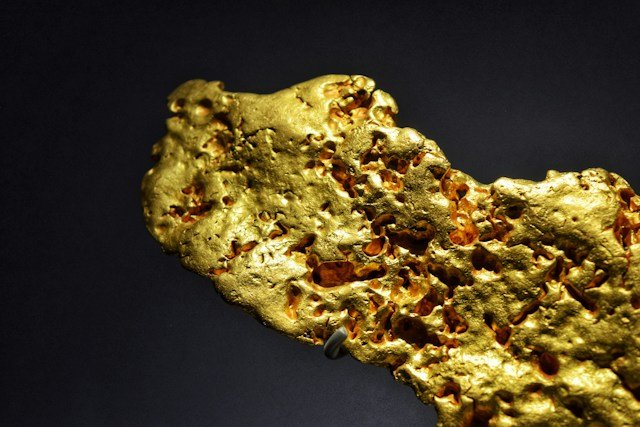
The lawsuit also points to a second AngloGold Ashanti prospect, the Arthur Gold Deposit, which the company estimates holds about 16 million ounces of gold, described in this week’s reporting as nearly five times Nevada’s annual production. That comparison is checkable against two independent government sources, and it holds up.
The Nevada Division of Minerals puts the state’s 2024 gold output at 3,479,748 troy ounces, down 13.7% from the year before, and projects a further 3% to 7% decline for 2025, which works out to roughly 3.24 million to 3.38 million ounces. Separately, the U.S. Geological Survey’s 2026 mineral commodity summary estimates total 2025 U.S. mine production at 160 metric tons.
Applying Nevada’s historical 64% to 70% share of that national total, the way the state’s own minerals division frames it, implies Nevada output of roughly 3.29 million to 3.6 million ounces for 2025. Dividing 16 million ounces by any of these independently sourced estimates lands between 4.4 and 4.9, confirming that “nearly five times” is a fair description, not an inflated one.
What’s Proposed Along the Amargosa
- North Bullfrog Project. About 5,400 acres of public land nine miles north of Beatty, in the Bureau of Land Management permitting process, with a water use figure reported two different ways, as shown above.
- Arthur Gold Deposit. An estimated 16 million ounces of gold, no public water use figure disclosed yet.
- Four more AngloGold Ashanti prospects and one additional, unnamed project make up the remaining proposals the lawsuit counts along the river, none with published water figures of their own.
A Third Attempt to List the Toad in Three Decades
This is not the Amargosa toad’s first brush with federal protection, and its history explains why advocates describe the current deadline as overdue rather than simply late.
- 1994. The Biodiversity Legal Foundation, since merged into the Center for Biological Diversity, petitioned for protection. The service denied it for insufficient information.
- 2008. The center petitioned again. The service denied that request too, citing a collaborative conservation agreement among local, state and federal agencies and area landowners.
- 2024. The center filed new petitions for both the toad and the speckled dace.
- 2025. The service found that protections “may be warranted,” triggering a one year clock for a final decision that the Endangered Species Act does not allow the agency to simply let expire.
- Feb. 2026. The center sent the service a 60 day notice of intent to sue over the missed deadline.
- Oct. 27, 2026. With no final decision issued, the center filed suit.
“The Amargosa toad and Oasis Valley speckled dace are emblems of Nevada’s remarkable biodiversity,” said Patrick Donnelly, the Center for Biological Diversity’s Great Basin director, in the Oct. 27 announcement. “The Amargosa River is a crown jewel of the Mojave Desert, and we shouldn’t sacrifice it for gold mining.”
Neither the U.S. Fish and Wildlife Service nor AngloGold Ashanti had issued a public response to the lawsuit as of this writing. The agency’s next legal deadline, and whichever water figure for North Bullfrog eventually makes it into a permitting document with the BLM’s name on it, will be the numbers worth checking next.